
ZNL FinOps · Google Cloud lab
Why did cloud spend rise?
Inspect measurements from a real Google Cloud workload, then investigate a missed shutdown across 12 development VMs. At sample rates, an eight-hour weekday schedule would save $3,264 per month.
Compute Engine instance scheduling · Simulated incident
What does a missed VM shutdown cost?
Your development team signs off at 5 p.m., but 12 development VMs keep running at a combined $6 per hour. The team uses these VMs for daytime integration tests. Monitor the hourly bill and investigate any spend above the scheduled baseline.
At eight hours per weekday, the schedule saves an estimated $39,168 over twelve modeled months. Play through one missed shutdown to investigate the overnight charges.
Hourly spend USD · storage + compute
Select an hourly bar to inspect compute and storage charges.
Measured in Google Cloud · 2026-11-23
Inspect two traffic bursts in Cloud Monitoring
ZNL deployed a private Cloud Run service in Oregon (us-west1) and sent two bursts of traffic. The Google Cloud Monitoring dashboard tracked request count and billable instance time for that service.
9requests recorded
0.590822 sbillable instance time
View the original Google Cloud dashboard
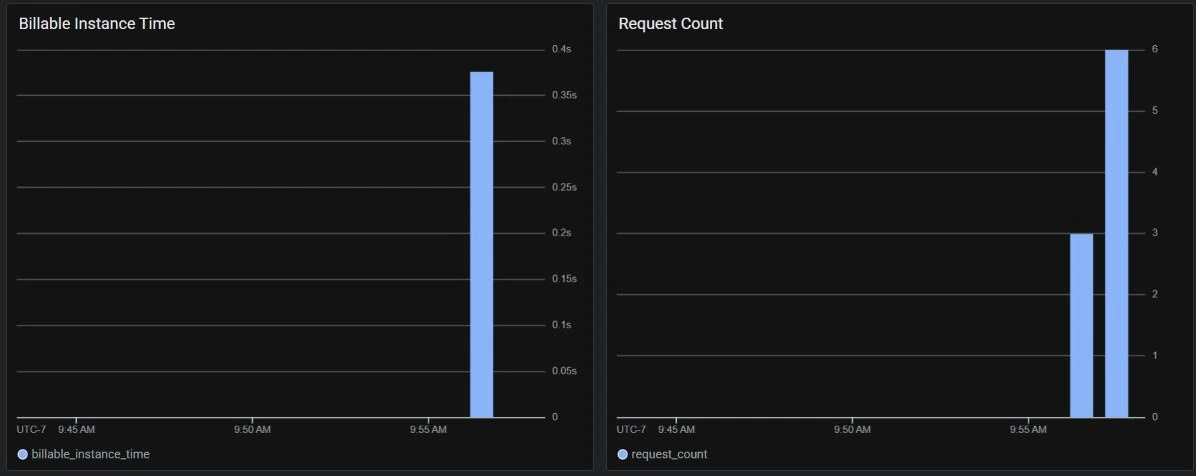
Inspect the dashboard samples
| Time | Requests | Instance seconds |
|---|---|---|
| 16:57:00 | 3 | 0.375531 |
| 16:58:00 | 6 | 0.215291 |
These workload measurements were collected during a one-time test. The separate exercise below uses sample prices to explore a monthly scheduling decision.
Investigate a sample weekly bill
Select a week to see what changed across the 12-VM fleet when its weekday shutdown stopped working.
Model a monthly schedule
Compare 12 always-on development VMs with a weekday schedule for a 30-day month containing 22 weekdays.
Weekend compute is stopped. Persistent storage stays allocated throughout the month.
See the calculation and assumptions
Per instance, the sample compute rate is $0.50 per running hour. Storage costs $0.80 per calendar day. The baseline is 720 compute hours plus $24 storage. The scheduled estimate uses 22 weekdays multiplied by your selected hours and hourly rate, plus $24 storage. Fleet totals multiply those amounts by 12. Annualized savings assume the same schedule for 12 modeled months. This model excludes commitments, taxes, network traffic, and other services.
Turn the estimate into a decision
Workload owner: Confirm who uses the development environment after hours. Check overnight jobs, backups, and the team’s time zone before scheduling shutdowns.
Platform team: In Compute Engine, create an instance schedule resource policy for weekday starts and stops in the team’s time zone. Attach it to one standalone development VM, verify a clean shutdown and morning startup, then roll it out to the remaining 11. Compare the next billing period with the estimate. Google Cloud instance schedule guide.
Review my cloud costs